Bobby Baxter Jokes
Recently, due to the unfortunate passing of Professor Bobby Baxter last year, we were lucky to receive a large collection of his handwritten letters, notes, etc. which we have been carefully going through in the hope of staging an exhibition on this great master of comedy and magic. Currently, however, we thought we would whet your appetite by disclosing a few of the jokes we have discovered, while going through everything, that we thought were particularly humorous. We are not sure if they are all original with Mr. Baxter, but hopefully they may provide a laugh or two:
- What is a royal flush? A drink made of Royal Crown and Prune Juice.
- I’ve reached an age where my back goes out more than I do.
- I tried to write a song about drinking, but I couldn’t get past the first two bars.
- At the hotel I called down for some Southern Comfort, and they sent up a maid from Memphis.
- Been thinking of buying an expensive see through shirt, but it seems a shame to spend so much to see so little.
- If you cross a fly with an elephant you know what you get? A zipper that never forgets.
- If you’re old try to live til Tuesday.
- Make old age fun, share your teeth with a friend.
- Remember, you don’t have to be an elevator to get the shaft.
Okay, hopefully those were enough to brighten everyone’s day. Please check back from time to time to see what other gems we have managed to locate.
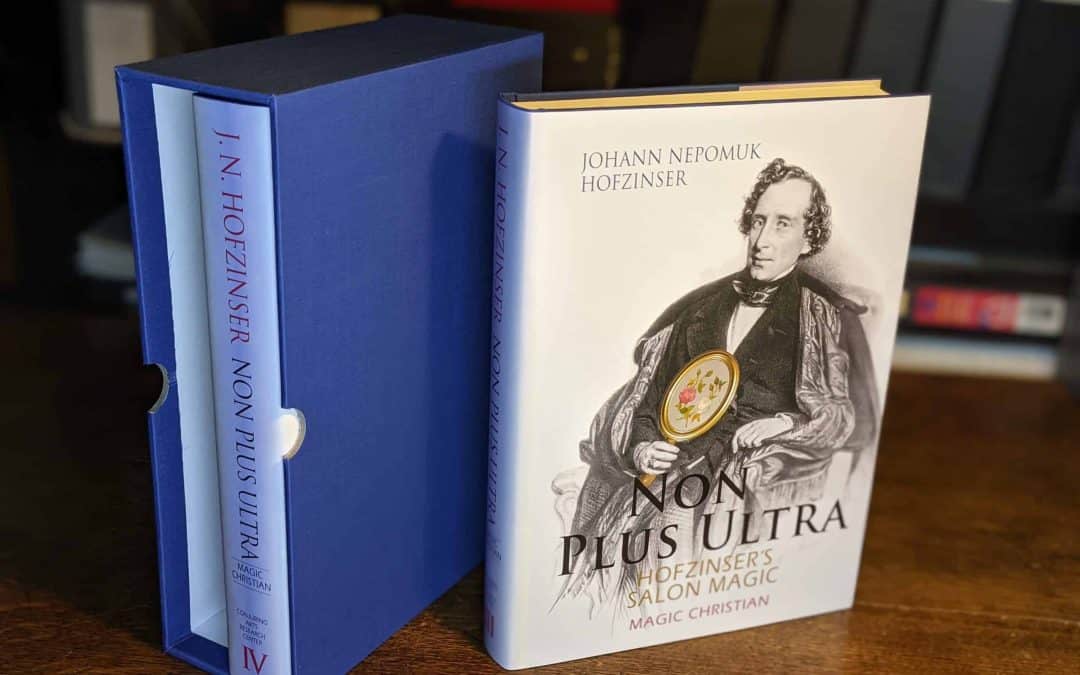
*Photo by Bill Wadman at Bobby Baxter’s apartment; http://www.billwadman.com.
Best wishes from Conjuring Arts,
Ricky Smith
Alexander: Good or Evil?
The following article, written by Mike Caveney, first appeared in the Conjuring Arts Bulletin: Vol.1, No.1
I recently had a spirited conversation with a group of magic collectors over the pros and cons of our very own database: Alexander – The Computer That Knows. Some suggested that any publisher who allowed his books to be scanned and uploaded onto the data base, was diluting the value of his books. The thinking being, if the information is available on line, why would anyone purchase a hard copy of the book? Others believed that the availability of this wealth of information far outweighed the potential loss of revenue to the publisher. As the owner of a niche publishing house myself (Mike Caveney’s Magic Words) it might surprise some to learn that I came down firmly in favor of the fattest possible Alexander. To my way of thinking, it’s a no brainer.
Fortunately for me, people who collect books on magic have an inherent flaw: they like the way books feel in their hands. Of course they enjoy the information these books contain but they also like the dust jacket, the gold stamping, the printed end sheets, the feel of the paper, and they enjoy seeing the spine of that book as is sits on their bookshelf. All elements that are not provided by a database. The fact that every word of these books is now on line does not change the fact that they enjoy holding that bound volume in their hands.
You might also say that with the advent of the Alexander database, I can take my entire collection of periodicals to the paper mill and have them pulped. Why not, its all on line anyway. Think of the space you’d save.
The truth is that Alexander has made my periodical collection even more valuable to me. There is nothing I enjoy more than finding numerous obscure references to some arcane subject on the Alexander database, then walking downstairs, pulling the original magazines off the shelf and settling into a comfortable chair to peruse magic history in its original form. Alexander has directed me to magazines that I haven’t peeked into for years and for that he has my undying gratitude.
And lastly, the number of people who are willing to join the Conjuring Arts Research Center so they can gain access to our wonderful pool of knowledge is not that large. I imagine they are mainly people actively engaged in the writing of a book or article about a subject that I will most likely enjoy reading. If having my books included in this pool of knowledge assists them in their task, and ultimately results in a more complete article, then we all win. And if that researcher finds him or her self reading a digitized book filled with interesting text, they might just decide to buy a copy. All of a sudden, instead of losing a customer, I just gained a new one.
If there is a down side to the Computer that Knows, I just don’t see it.
Rewriting History: From Paper to Pixels
The following article, written by David Charvet, first appeared in the Conjuring Arts Bulletin: Vol.1, No.1
Having been studying and writing about magic history for over 30 years now, it has been remarkable to witness the changes that technology has brought to the task of research.
As a teenager, in about 1975 B.C. (Before Computers) I would spend hours in the downtown Seattle Public Library pouring over old copies of the New York Times and Seattle Post-Intelligencer, looking for ads and stories about the great magicians of the past. In those days, the Periodical Desk at the library would hand you huge bound volumes containing real, honest-to-goodness copies of the newspapers. I remember well the musty smell of ancient newsprint. I also remember reading the stories about the death of Houdini, looking at the same newspaper that someone else had, a half century before me. A few years later, when the library converted their files to microfilm, all of these wonderful bound volumes of newspapers vanished. Visits to the library were never quite the same again for me. I missed the smell of history.
Most serious magic historians own complete files of Sphinx, Genii and other periodicals, as well as libraries filled with the most popular books on the subject from the past 130 years (if one uses Hoffmann’s Modern Magic as the starting point for popular magic literature.) While that great smell of history is there, the real key in research is in finding the material when you need it.
Jack Potter made the Herculean effort to index and cross reference every popular trick and effect published roughly from 1876 through the early 1960’s, sharing his results serially as Potter’s Bar in the Linking Ring, and later as a series of volumes from Micky Hades. Potter’s index was an amazing feat in itself during those pre-computer days. However, Potter was interested only in documenting references to tricks and methods, not news and personalities from the magic world. This was in keeping with the times, when most magicians were primarily interested in the techniques and not the people who made the magic.
The magic historian was left with the task of sorting through thousands of pages in books and magazines, literally one line at a time. Hour upon hour could be spent searching for one reference. At times it was akin to looking for the proverbial needle in a haystack.
With the advent of the computer age, and the OCR software necessary to scan printed pages and convert them to pixels, a whole new world has opened for the magic researcher. Bill Kalush and Conjuring Arts have certainly led the way in our field.
No longer is it necessary to sit cloistered in a library. Now, with a laptop computer and an internet connection, one can relax at their local Starbucks with a cup of coffee and watch as the history of magic unfolds before them.
My latest project is writing the definitive biography of Harry Willard, and the saga of those who performed as “Willard The Wizard.” While I have accumulated many great stories about Willard, due to the nature of his traveling life many of the dates and places of those events have fallen through the cracks. So recently, I called upon the Ask Alexander database for help. Within seconds of typing “Willard The Wizard” on my keyboard, the search engine found 152 references to Willard among 62 documents in the Conjuring Arts collection.
Besides the usual magic publications, it was interesting to find references from non-hobby sources, such as The Billboard magazine. For example, in his January 17, 1948 Magic column, Bill Sachs wrote: “Caught Willard the Wizard in Carmine, Texas. He carries seven people and 16 illusions and gives a two-hour show. Well timed and perfect.” Sachs was a seasoned theatrical reporter, who had seen all of the greats of the era, which makes this short notice especially interesting. Two weeks later, in the January 31st column, Virgil wrote to Sachs: “One who has never caught Willard’s performance can’t conceive of the magnitude of the show. Willard has most all of the big illusions that have been done by other magicians plus a few of his own creation. The numerous trucks and trailers he uses give his show the appearance of a circus.” These notices are just two examples of the type of material that one could have previously spent days searching for, but is now available in just seconds via AskAlexander.org.
So what does this technology hold for the magic historians of the future? Much like television was in 1948, we are just beginning to unravel the potential of internet-based research tools. No doubt new research could be done on just about any figure in the history of magic and today you’d find more information than even one year ago, thanks to the databases now available. For the first time to the magic historian, the future is starting to look as interesting as the past. Now if they could just bring back that great musty smell….
Will the Real Chang Please Stand Up
The following article, written by Mike Caveney, first appeared in the Conjuring Arts Bulletin: Vol.1, No.2
My wife, Tina Lenert, and I were recently invited to perform at a magic festival in Badalona, Spain, a suburb of Barcelona. It was not a magic convention, but rather a festival geared to the lay community. We did three shows in a beautiful, hundred-year-old theater and the sold-out audiences were great.
Before leaving the States, I was told that this festival was honoring that great magician from the past – Chang. Upon hearing this, I was immediately transported back to age thirteen when I attended my first real magic show: Milt Larsen’s It’s Magic. The closing act was Chang – Latin America’s Greatest Magician.
I thought it a bit odd that a festival in Spain would be honoring a Panamanian illusionsit but that didn’t stop me from pulling a number of posters, programs and photographs out of Egyptian Hall Museum and carrying them with me to Spain. I thought I would surprise them with a nice display.
Every night after the show the entire cast enjoyed a huge dinner that never ended before 1:00 am. On the first night we were joined by Joan Maria Forns, the son of Chang. He was anxious to see what I had so I ran back to the theater to retrieve my treasures. Upon seeing the first photograph Joan said, “That’s not my father.”
Now it was my turn to be surprised.
To make a long story short: there were two Changs. The man that I saw in my youth was Juan José Pablo Jesorum and he was indeed born in Panama on December 2, 1889. Early in his career he used the name Li Ho Chang, later shortening it to simply Chang. He enjoyed a very long career that took him to Australia, China, Africa, India, Europe and America but his greatest success came in Central and South America where he lived and worked most of his life.
When I saw him in 1963 he was well past his prime at the age of 74. Being the first great illusionist I ever saw, my memories of him include gorgeous costumes, beautiful girls, well-trained assistants and huge illusions. Many years later, Milt Larsen told me the real behind-the-scenes story.
Milt had been instructed to meet the Great Chang at the bus station in downtown Los Angeles. There he encountered an old man carrying two battered suit-cases. Milt looked around for the truck carrying Chang’s show.
He soon learned that the suitcases were filled with costumes and a few tricks. That was the show.
Springing into action, as he had so many times before, Milt rallied the forces. Bob Towner, Bob Fenton, Bev Bergeron and George Boston were enlisted as assistants and there were always plenty of pretty girls around the newly opened Magic Castle. Some illusions were trucked in from Dante’s ranch. Having spent his entire career presenting a full-evening show, Chang was in no way intimidated by the props and people that now swirled around him. His vast experience and abilities as a showman would serve him well. To a wide-eyed, thirteen-year-old kid, this master mystifier commanded the stage and did not disappoint.
The father of the man I was dining with in Badalona, Spain was named Joan Forns and he also enjoyed a long career performing a Chinese magic act as Li-Chang. As a young man he had seen Fu Manchu’s spectacular show and by 1933 he had assembled his own show and was performing at Circ Olympia in Barcelona. It would appear that most of his career was spent in a circus ring. Europe has always been home to dozens and dozens of small, one-ring circuses and they often featured a magician. Of course Li-Chang’s act had to be carefully constructed to safely work in the round but once that was accomplished, he found plenty of work on the “sawdust circuit.”
It would also appear that the majority of Li-Chang’s career was spent performing in Spain though he did make limited forays into France (at the Moulin Rouge in 1956), England (Bertram Mills Circus 1964), Italy, Portugal, Germany and North Africa.
In 1947-48 Panama’s Chang was appearing in Barcelona, Spain and it was here that the two Changs finally met.
Juan Pablo Jesorum was still performing at the age of 82 when he died in Yucatan, Mexico in 1972. Joan Forns died at age 81 in Barcelona, Spain on January 12, 1998.
Before leaving Badalona I was given a full-color book published by the Badalona Museum in 2004 on the life of Joan Forns: Li-Chang. The text is written in Catalan (a language spoken in the northeast region of Spain) but it is filled with beautiful graphic images from througout Li-Chang’s long career.
Returning home, I checked the usual sources (David Price, Milbourne Christopher) and found no refrence to Spain’s Li-Chang which led me to suspect that I was not the only one who believed in the one-Chang theory.
Having recently examined a number of photos, programs, letters, Christmas cards, newspaper reviews and posters, I now believe that Panama’s Juan José Pablo Jesorum was always called Li Ho Chang early in his career and Chang later on. Spain’s Joan Forns always used the name Li-Chang.
Egyptian Hall has a number of Li-Chang posters subtitled El Demonio Amarillo (The Yellow Demon). I always assumed that these advertised Panama’s Chang but I now believe that they were printed for Joan Forns in Spain (perhaps Valencia) in 1946.
I would like to thank Enric Magoo for inviting us to Spain where this entire mystery was ultimately solved. And thanks also to Joan Maria Forns, son of Li-Chang, who spent years working as an assistant in his father’s show, for a wonderful evening of stories that brought another small piece of magic history into clearer focus.
When in Doubt – Ask Alexander
The following article, written by Mike Caveney, first appeared in the Conjuring Arts Bulletin: Vol.1, No.2
During the first couple of decades of the twentieth century “ask Alexander” meant drop a question (along with a dollar bill) into an envelope and send it to 239 South Oxford Avenue in Los Angeles. By return mail your question would be answered by Claude Conlin aka Alexander the Man Who Knows.
These days, to magic historians around the world, “ask Alexander” are the words spoken just before you sit down at your computer and type a name into AskAlexander, the Conjuring Arts Research Center’s massive data base. Claude Conlin pretended to have all the answers but AskAlexander seemingly does have all the answers.
A few months back I needed some answers about Alexander the mentalist and instead of visiting my favorite web site, I turned off my computer and actually visited The Man Who Knows. OK, it was the son of The Man Who Knew but at this late date, that was as close as anyone was going to get to the man.
In 2004 I published David Charvet’s book on Alexander and it proved to be the fastest selling book in our series of Magical Pro-Files. Within eighteen months, it was out of print. During that time, Alexander’s son, John Conlin, moved from Arizona to within a half-an-hour drive from my house. David Charvet and I joined him for dinner one evening and we soon learned that he was indeed a chip off the old block. The stories were unceasing and each one was more incredible than the last.
I believe John Conlin is the only person I’ve ever met who can say he shook hands with Harry Kellar. When John described a photo he had of a Pantages Theater with crowds of people lined up outside and a huge Alexander billboard visible above the entrance, I said we would love to see it. “Sure,” John said, “it’s up in my room.” Later that evening he pulled four huge scrapbooks out of his closet and said, “Here, it’s in one of these.” David and I sat there slack-jawed as we paged through the mother lode of Alexander memorabilia.
Any thoughts I had of merely reprinting the Alexander book vanished in an instant. Anything less than a whole new book would be an insult to this wonderful archive. With the generous help of John and his son, Alexander Patrick Conlin, these scrapbooks traveled to the Magic Words office where dozens of images were scanned. And just when David thought his days of researching the life of Alexander were over, he was back in the thick of it.
Since the publication of the first book, I have come to know Cathy Stevenson, granddaughter of Alexander’s brother, CB Conlin, and the Conlin family historian. Cathy agreed to organize the results of her considerable research into an appendix. Here we learn that CB Conlin starred as Psycho in his own mind-reading act and experienced adventures that rivaled those of his infamous brother.
The new expanded edition of Alexander – The Man Who Knows is now available at Mike Caveney’s Magic Words